Long before ghost towns, alien conspiracies, or modern missing-person cases, there was the Roanoke Colony. A settlement that vanished so completely it left behind nothing but questions, whispers, and one chilling word carved into wood.
This is not just history. This is one of the most unsettling mysteries in North America.
Known today as Roanoke the Lost Colony, the disappearance of more than one hundred men, women, and children from Roanoke Island remains unsolved over four centuries later. No bodies. No signs of struggle. No clear explanation.
Only silence.
The Birth of the Roanoke Colony
In 1587, English settlers arrived on Roanoke Island, located off the coast of what is now North Carolina. Sponsored by Sir Walter Raleigh, the goal was ambitious: establish England’s first permanent settlement in the New World.
The group consisted of around 115 colonists, including families and children. Also among the colonists was Virginia Dare, a child whose birth symbolized England’s first foothold in the Americas. The settlement was meant to be a fresh start.
Instead, it became a nightmare frozen in time.
Supplies ran low quickly. Relations with local Native American tribes were tense. Food was scarce. Desperation grew.
So the colonists made a decision that would seal their fate.
John White’s Departure and a Fatal Delay
John White, the governor of Roanoke Colony, returned to England to gather supplies. The plan was simple. He would leave temporarily and come back quickly.
But history intervened.
England went to war with Spain. The Spanish Armada threatened invasion. All ships were ordered to stay and defend the homeland. White was trapped.
What was meant to be a short absence turned into three long years.
When John White finally returned to Roanoke Island in 1590, he expected relief, gratitude, maybe exhaustion.
What he found instead was terror.
An Empty Settlement and a Single Word
The Roanoke Colony was completely abandoned.
Homes had been dismantled, not destroyed. There were no signs of battle. No graves. No remains. No blood. Even valuable items were gone.
The colonists had vanished.
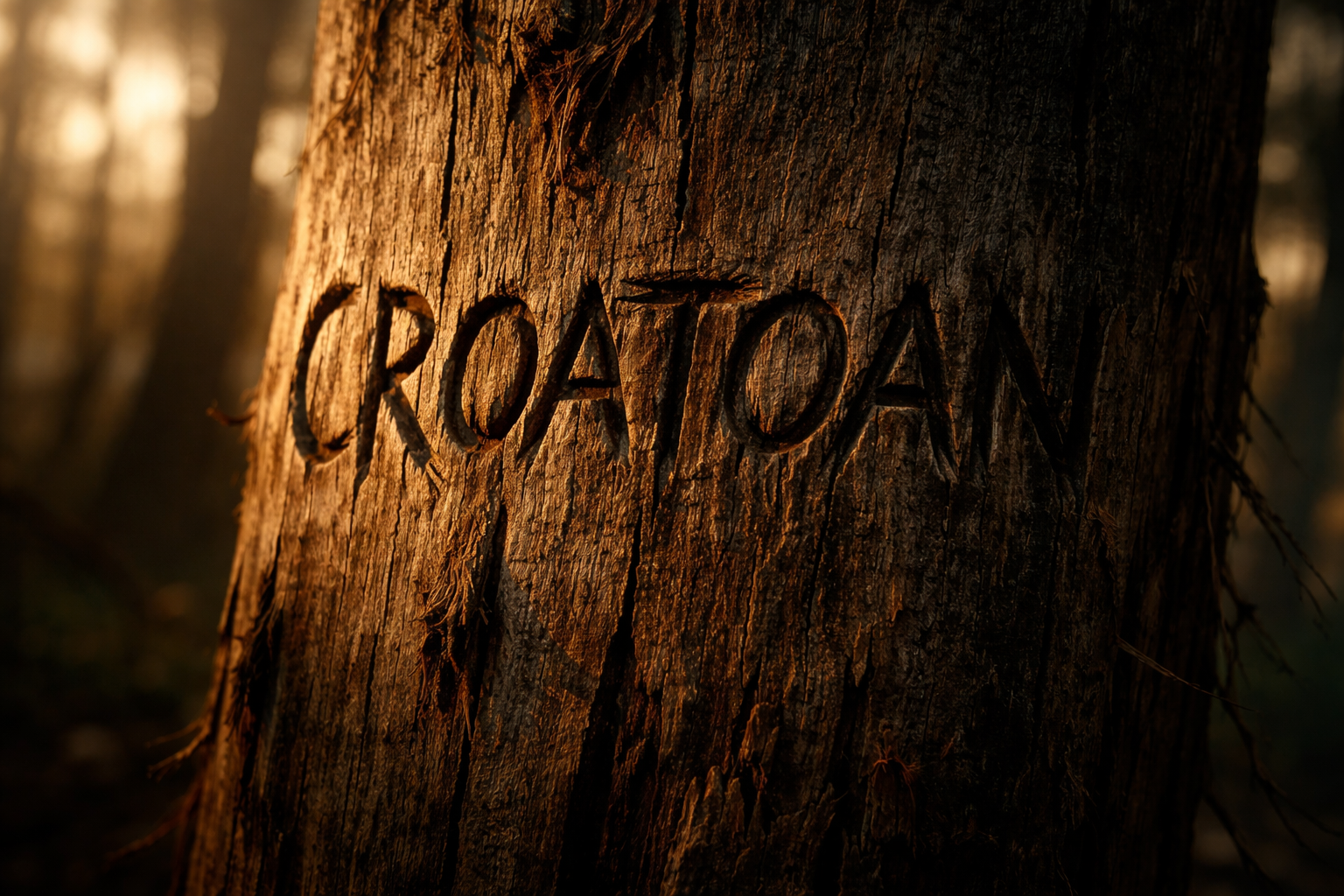
Nothing remained of the colony except a single word, roughly carved into a wooden post:
“CROATOAN”
And three letters carved into a nearby tree:
“CRO”
No explanation. No message. Just a word.
That word would become the heart of the Roanoke Colony Mystery.
What Did “Croatoan” Mean?
The term ‘Croatoan’ pointed to a nearby island and the Native American tribe residing there. Before leaving, the colonists had agreed on a code with John White.
If they left willingly, they would carve their destination.
If fear or force drove them away, the colonists were to leave a Maltese cross behind.
There was no cross.
This suggests the colonists left on their own terms.
But that only raises a darker question.
Why would an entire colony abandon everything… and never be seen again?
Theory One: Assimilation Into Native Tribes
One of the most widely accepted explanations is that the settlers joined local tribes, possibly the Croatoan people.
There are historical accounts of Native Americans with gray eyes or European features appearing years later. Some tribes claimed ancestors who spoke English or practiced Christianity.
Recent DNA studies have hinted at European ancestry among certain Native American communities.
This theory explains survival.
But it does not explain silence.
Why no written records? Why no clear confirmation? Why did no one ever return?
Theory Two: Massacre and Erased Evidence
Another theory suggests a far darker fate.
Tensions between settlers and Native tribes were high. Food shortages could have sparked violence. A coordinated attack may have wiped out the colony.
Supporters of this theory argue that bodies could have been removed or disposed of, and structures dismantled afterward.
However, this explanation struggles with one major problem.
There were no signs of violence.
No burned buildings. No weapons. No remains.
If a massacre occurred, it was disturbingly clean.
Theory Three: Starvation and Desperate Migration
Some historians believe the colonists attempted to migrate inland after crops failed. Roanoke Island was vulnerable, isolated, and difficult to defend.
The settlers may have scattered in small groups, seeking food and shelter. Over time, they may have died from starvation, disease, or exposure.
This theory paints a slow, tragic end rather than a single event.
But once again, no evidence has ever been found.
Not even a trace.
Theory Four: The Conspiracy Angle
This is where Roanoke the Lost Colony takes on a more unsettling tone.
Some believe the truth was deliberately buried.
England had political reasons to downplay failure in the New World. A vanished colony would have discouraged future settlements. Records may have been destroyed. Stories rewritten.
Others go even further, suggesting something unnatural occurred. Strange weather patterns. Reports of cursed land. Native legends warned settlers not to remain.
Was Roanoke Island haunted long before the English arrived?
No proof exists. But the absence of proof is exactly what feeds the conspiracy.
Archaeological Clues That Raise More Questions
Over the years, artifacts have been found far from Roanoke Island. European tools, weapons, and personal items discovered inland suggest the colonists may have moved.
One site, known as Site X, revealed items matching the Roanoke period.
Instead of solving the mystery, these findings fractured it.
If the colonists moved, why did they not leave clearer records? Why did no survivors ever contact English settlements later established nearby?
The trail ends abruptly.
Every time.
Why the Roanoke Colony Mystery Still Haunts Us
What makes the Roanoke Island lost colony so terrifying is not just that people disappeared.
It is how completely they vanished.
Entire civilizations usually leave scars. Ruins. Bones. Something.
Roanoke left a word.
And nothing else.
That silence allows imagination to take over. It compels us to consider a possibility that feels deeply wrong. That an entire community can simply… disappear.
Roanoke in Modern Culture and Legend
The mystery of the Roanoke Colony has inspired books, documentaries, television series, and horror stories. It is often portrayed as cursed ground, a warning about human arrogance, or a place where reality itself bends.
Some locals claim the area still feels wrong. Fog rolls in suddenly. Sounds carry strangely. Stories of ghostly figures persist.
Whether these are legends or coincidences, they keep Roanoke alive in the public imagination.
Final Thoughts: The Colony That Refused to Be Found
More than four hundred years later, Roanoke Colony remains one of history’s most chilling unsolved mysteries.
No confirmed survivors.
No graves.
No definitive explanation.
Only theories layered on top of silence.
Perhaps the truth lies buried beneath the soil of Roanoke Island. Or perhaps it was never meant to be found.
The settlers vanished, but their question remains.
What happened to Roanoke the Lost Colony?
And why does history still refuse to answer?
Why is Roanoke called the Lost Colony?
Roanoke is called the Lost Colony because every settler vanished without explanation between 1587 and 1590. No bodies, graves, or definitive records were ever found, leaving historians unable to determine what happened to them.
What does the word “Croatoan” mean?
“Croatoan” was the name of a nearby island and the Native American tribe that lived there. It was found carved into a wooden post at the abandoned settlement, suggesting the colonists may have relocated there voluntarily.
Was the Roanoke Colony ever found?
No, the Roanoke Colony was never conclusively found. While archaeological evidence suggests some colonists may have moved inland or joined Native tribes, no definitive proof has confirmed their final fate.
Did the Roanoke colonists join Native American tribes?
One leading theory suggests the settlers assimilated into nearby Native American tribes, such as the Croatoan. Some historical accounts and limited DNA evidence support this idea, but it has never been fully proven.
Who was Virginia Dare and what happened to her?
Virginia Dare was the first English child born in the New World and a member of the Roanoke Colony. Like the other colonists, her fate is unknown, making her one of the most famous figures associated with the mystery.
Was the Roanoke Colony destroyed by violence?
There is no physical evidence of a massacre at Roanoke. The absence of bodies, weapons, or burned structures makes large-scale violence possible but unproven, leaving this theory unresolved.
Is the Roanoke Colony Mystery solved?
No, the Roanoke Colony Mystery remains unsolved. Despite centuries of research, archaeological digs, and historical analysis, no single explanation has been universally accepted.
Where was Roanoke Island located?
Roanoke Island is located off the coast of present-day North Carolina. It was the site of England’s first attempted permanent settlement in North America and is central to the Roanoke Island lost colony mystery.
Why is the Roanoke Colony still important today?
The Roanoke Colony is important because it represents the first major English attempt at colonization in America and remains a powerful symbol of unexplained disappearance, survival, and historical uncertainty.