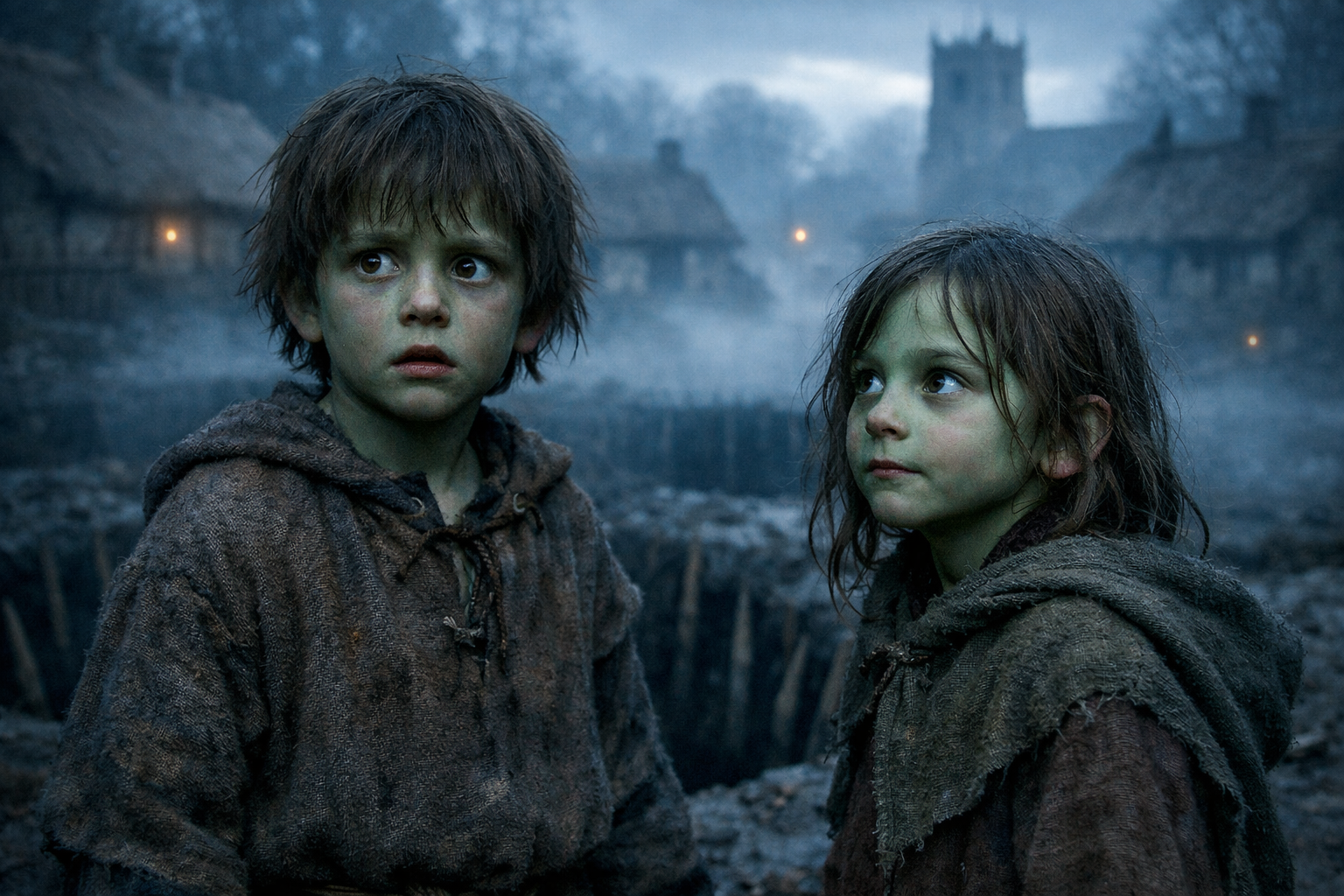
In the quiet countryside of Suffolk, England, lies the village of Woolpit. At first glance, it is unremarkable. Rolling fields, narrow lanes, and a history typical of many English villages. Yet Woolpit holds one of the most baffling and unsettling stories in medieval history. A story that has puzzled historians, folklorists, scientists, and conspiracy theorists for centuries. This is the legend of the Green Children of Woolpit.
Were they lost children suffering from a rare illness? Refugees from another land? Victims of underground living? Or something far stranger, perhaps even not of this world? The truth remains unknown, and that uncertainty is exactly what keeps the mystery alive.
The First Recorded Encounter in Woolpit
The story of the green children of Woolpit dates back to the 12th century, during the reign of King Stephen of England, around 1135 to 1154. What makes this legend especially compelling is that it was recorded by two respected medieval historians: William of Newburgh and Ralph of Coggeshall. These were not storytellers or entertainers. They were chroniclers who aimed to record real events.
According to their accounts, villagers near Woolpit discovered two children, a boy and a girl, wandering near a series of deep pits used to trap wolves. These pits are widely believed to be the origin of the village’s name: “Woolpit.”
The children were clearly human. But something was very wrong.
The Green Skin That Shocked the Village
Both children had green-colored skin, an unnatural shade that immediately alarmed the villagers. Their clothes were strange, made from unfamiliar materials, and their speech was completely unintelligible. No one in Woolpit recognized their language, their clothing, or their appearance.
At first, the villagers believed the children might be spirits or cursed beings. Medieval England was a deeply superstitious place, and unexplained phenomena were often linked to divine punishment or supernatural forces.
The children refused all food except raw green beans, which they devoured with desperation. Bread, meat, and fruit were ignored. Only beans seemed acceptable to them.
This detail alone has fueled countless theories over the centuries.
The Boy’s Death and the Girl’s Survival
Sadly, the boy did not survive long after being found. He fell ill and died, leaving his sister as the sole living witness to their origins. Over time, something remarkable happened.
As the girl slowly adapted to normal food, her green skin began to fade.
Eventually, her skin tone became completely normal.
This transformation raised even more questions. Was the green coloring caused by diet? Environment? Disease? Or something else entirely?
The girl was later baptized and raised in England. Historical records suggest she lived for many years and was known to be somewhat wild in behavior, possibly traumatized by whatever experience brought her to Woolpit.
The Girl’s Shocking Story of Origin
Once the girl learned to speak English, she revealed an explanation that only deepened the mystery.
She insisted that she and her brother had come from a distant land called St. Martin’s Land.
According to her, this place was not like England. There was no sun as people knew it, only a constant twilight. Everyone in her land had green skin. The world was divided by a wide river, beyond which lay a bright land she had never visited.
One day, while tending animals, the children followed the sound of bells. Suddenly, they became disoriented. When they regained awareness, they found themselves in the bright sunlight near Woolpit.
Then they were discovered.
Historical Explanations for the Green Children of Woolpit
Over the centuries, scholars have tried to explain the green children of Woolpit using historical and scientific reasoning.
1. Nutritional Deficiency
One of the most widely accepted theories is that the children suffered from chlorosis, also known as “green sickness.” This condition, caused by severe iron deficiency, can give the skin a greenish tint.
Combined with malnutrition and a diet limited to raw vegetables, this explanation seems plausible. When the girl began eating a proper diet, her skin color returned to normal.
2. Flemish Refugees
Another theory suggests the children were Flemish immigrants. During the 12th century, political violence forced many Flemish families to flee. Some settled in England, particularly in eastern regions like Suffolk.
Their strange clothing, foreign language, and unfamiliar customs could explain the villagers’ confusion. The green skin might have been exaggerated over time or caused by illness and stress.
However, this theory struggles to explain the girl’s detailed account of St. Martin’s Land.
The Underground World Theory
One of the most intriguing explanations is that the children came from an underground civilization.
In medieval Europe, legends of hidden subterranean worlds were common. If the children lived in darkness or near darkness, their pale green skin could be a biological effect of limited sunlight.
When they emerged into the bright world above ground, they were overwhelmed, confused, and physically unwell.
The deep wolf pits near Woolpit may have served as entrances to such underground passages. While there is no physical evidence of an underground society, the idea remains popular among mystery researchers.
Conspiracy Theories and Otherworldly Possibilities
For those who reject conventional explanations, the green children of Woolpit represent something far more unsettling.
Interdimensional Travelers
Some believe the children crossed over from a parallel world. The girl’s description of a twilight land divided by a river fits eerily well with modern theories of alternate dimensions.
The sudden transition, the unfamiliar environment, and the physical changes could all point to interdimensional displacement.
Extraterrestrial Origins
Others go further, suggesting the children were extraterrestrial beings. While this theory lacks evidence, it persists due to the children’s unusual skin color, strange language, and unexplained arrival.
In conspiracy circles, the green children of Woolpit are often cited as one of the earliest recorded encounters with non-human visitors.
Why the Mystery Endures
What makes the green children of Woolpit so compelling is not just the story itself, but its credibility. This was not a folktale passed down orally. It was recorded by educated men who believed they were documenting real events.
No definitive explanation has ever been proven. Each theory answers some questions while raising new ones.
And perhaps that is the point.
Woolpit Today: A Village Marked by Legend
Today, Woolpit embraces its strange history. Signs, artwork, and local references keep the legend alive. The village has become a destination for history lovers, mystery seekers, and those fascinated by the unexplained.
The green children of Woolpit have become part of England’s cultural fabric, a reminder that even well-documented history can leave room for doubt and wonder.
Final Thoughts on the Green Children of Woolpit
Whether the green children of Woolpit were victims of disease, refugees from a distant land, or something far stranger, their story continues to challenge our understanding of the past.
In a world obsessed with certainty, this medieval mystery refuses to be solved.
And maybe that is why it still matters.
Because sometimes, the unanswered questions are more powerful than the answers we think we want.
Was the Green Children of Woolpit story real?
Yes, the event was documented by medieval chroniclers, though the true explanation remains unknown.
What caused the green skin of the Woolpit children?
Possible explanations include nutritional deficiency, illness, underground living conditions, or more speculative theories.