Imagine discovering an object that looks surprisingly similar to a modern battery—except it was buried beneath the sands of ancient Mesopotamia nearly 2,000 years ago. Could an ancient civilization have understood electricity long before Benjamin Franklin, Alessandro Volta, or Thomas Edison? Or is this one of history’s greatest archaeological misunderstandings?
Few ancient artifacts have sparked as much curiosity and debate as the Baghdad Battery. For decades, it has inspired historians, scientists, engineers, and conspiracy theorists alike. While no one knows its true purpose with complete certainty, the discovery continues to spark debates about the technological capabilities of ancient civilizations.
In this article, we’ll explore the Baghdad Battery, its discovery, construction, possible uses, scientific experiments, and why it remains one of history’s greatest unsolved puzzles.
What Is the Baghdad Battery?
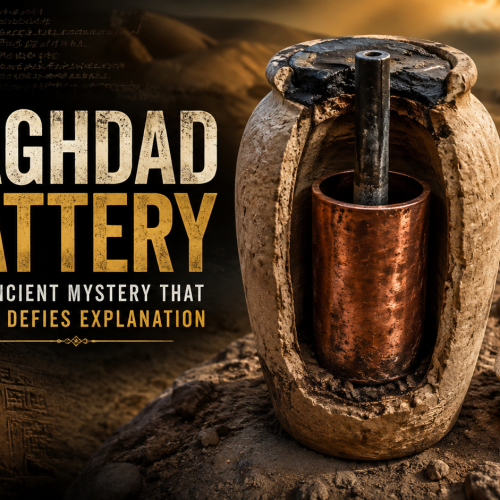
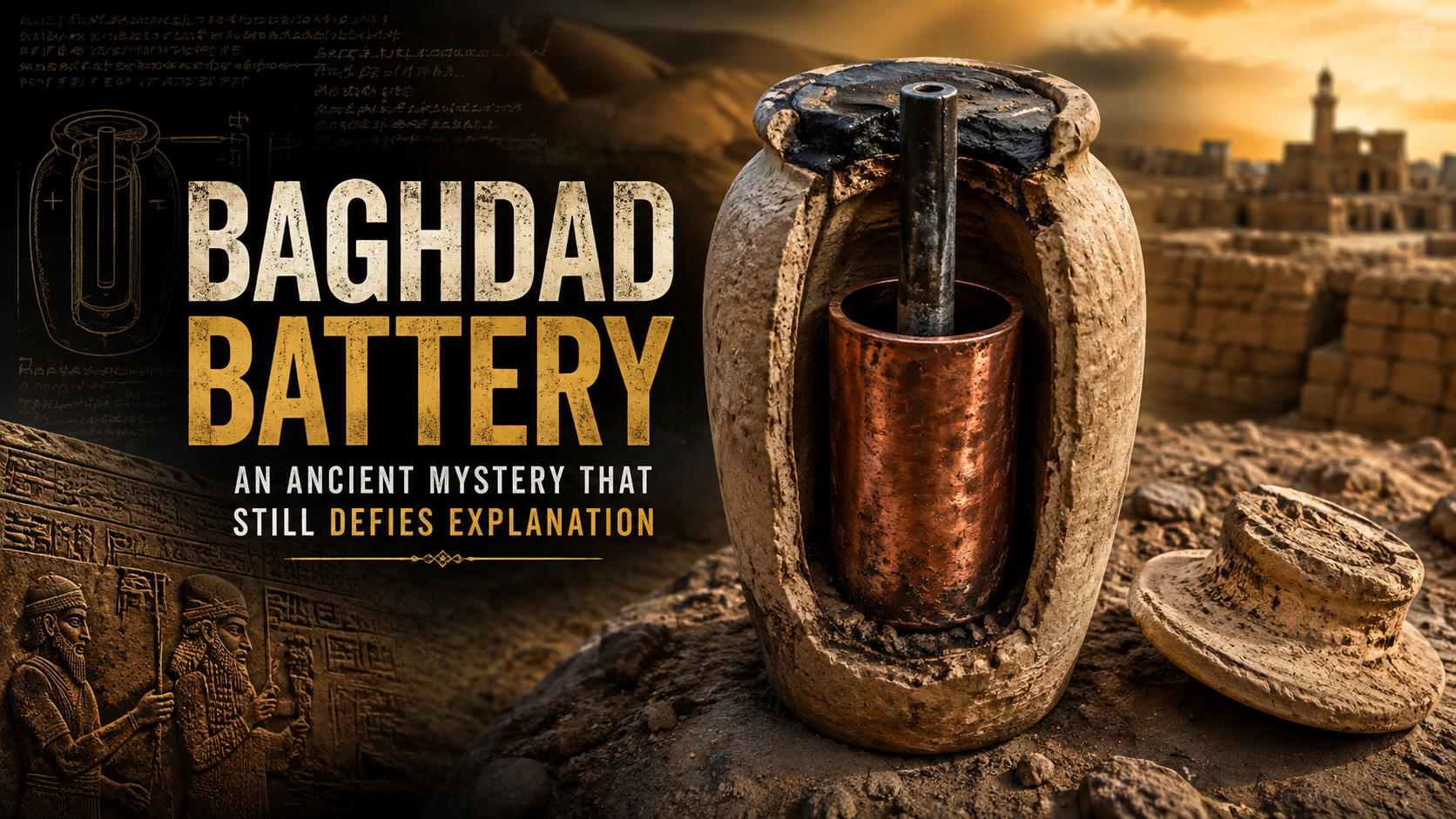
The Baghdad Battery refers to an ancient artifact discovered near Baghdad, Iraq, that resembles a primitive electrochemical cell. It consists of three main components:
- A small clay jar
- A copper cylinder placed inside the jar
- An iron rod positioned within the copper cylinder
The entire assembly was sealed with bitumen (natural asphalt), preventing the metal components from touching each other.
Although it appears simple, this unusual combination has led many researchers to speculate that the device may have been capable of producing a small electric current if filled with an acidic liquid such as vinegar, grape juice, or lemon juice.
Whether this was intentional or purely accidental remains one of archaeology’s biggest questions.
Discovery of the Baghdad Battery
The artifact was discovered during excavations near Khujut Rabu, close to modern-day Baghdad, in the 1930s.
German archaeologist Wilhelm König, who worked at the Iraq Museum, became intrigued by the object’s unusual design. After examining it, he proposed that it might have functioned as an early battery.
This bold suggestion immediately attracted worldwide attention because, if correct, it would completely change our understanding of ancient technological development.
However, many archaeologists remained skeptical, arguing that appearance alone does not prove electrical use.
How Could the Baghdad Battery Work?
Modern batteries generate electricity through chemical reactions between two different metals immersed in an electrolyte.
Interestingly, the Baghdad Battery contains two different metals:
- Copper
- Iron
If an acidic solution were poured inside the jar, the metals could theoretically create a small voltage through electrochemical reactions.
Scientists who recreated the artifact found that it could generate approximately 0.5 to 1 volt of electricity depending on the liquid used.
Although this is far weaker than modern batteries, connecting several such devices together could potentially produce higher voltages.
This discovery fueled even more speculation about the true purpose of the mysterious object.
Possible Uses of the Baghdad Battery
Because there is no surviving written record describing the artifact, historians have proposed several theories.
1. Electroplating Metals
The most popular theory suggests that the Baghdad Battery may have been used for electroplating.
Electroplating involves depositing a thin layer of one metal onto another using electricity.
Supporters of this theory argue that ancient craftsmen could have coated jewelry or decorative objects with precious metals such as gold or silver.
Although experimental recreations have shown that electroplating is technically possible with low-voltage batteries, no definitive archaeological evidence confirms that ancient Mesopotamians actually used this technique.
2. Religious or Healing Device
Another theory proposes that the artifact was used during religious ceremonies.
A slight electric shock generated by the device could have appeared miraculous to people unfamiliar with electricity.
Some researchers speculate that priests may have used the sensation as part of sacred rituals or healing practices.
However, no historical texts currently support this idea.
3. Storage Container
Many archaeologists believe the simplest explanation is the most likely.
The clay jar may simply have served as a storage container for scrolls, sacred objects, or valuable materials.
The copper cylinder could have protected fragile contents rather than generating electricity.
Without additional evidence, this remains an equally plausible explanation.
4. Scientific Experiment
Some historians suggest the object might have been part of early chemical experimentation rather than a practical battery.
Ancient civilizations possessed remarkable knowledge of metallurgy, dyes, perfumes, and chemical reactions.
The unusual combination of metals may have been connected to these fields instead of electricity.
Scientific Experiments
Over the years, several researchers have recreated the Baghdad Battery using materials similar to the original artifact.
When filled with acidic liquids such as:
- Vinegar
- Lemon juice
- Wine
- Grape juice
the replicas successfully generated measurable electrical voltage. These experiments demonstrated that the design can indeed function like a battery. However, demonstrating that something can work is not the same as proving that ancient people intended it to work that way. This distinction lies at the heart of the ongoing debate.
Why Many Experts Remain Skeptical
Despite decades of fascination, many archaeologists do not believe the artifact was an actual battery.
Several important questions remain unanswered:
- No electrical wires were found nearby.
- No connected electrical devices have ever been discovered.
- There is no historical documentation describing electricity.
- No evidence confirms large-scale electroplating using similar devices.
- Only a few comparable artifacts have been found.
Without supporting evidence, many scholars argue that the battery hypothesis remains speculative.
In archaeology, extraordinary claims require extraordinary evidence.
Ancient Technology Was More Advanced Than We Often Imagine
Regardless of whether it generated electricity, the Baghdad Battery reminds us that ancient civilizations possessed remarkable engineering abilities.
People living thousands of years ago constructed:
- Massive pyramids
- Sophisticated irrigation systems
- Precision astronomical observatories
- Complex metalworking techniques
- Advanced road networks
The mysterious jar demonstrates that ancient inventors often experimented with materials in ways that still surprise modern researchers.
Even if the object ultimately proves not to be a battery, it remains an extraordinary example of ancient craftsmanship.
The Debate Continues
The mystery surrounding the Baghdad Battery has inspired countless documentaries, books, museum exhibits, and scientific discussions.
Some view it as evidence that forgotten technologies once existed.
Others believe it illustrates how modern interpretations can sometimes project today’s understanding onto ancient artifacts.
Until new archaeological discoveries emerge, neither side can claim complete victory.
This uncertainty is precisely what makes the artifact so captivating.
Final Thoughts
Few archaeological discoveries have generated as much curiosity as the Baghdad Battery. Whether it was an ancient electrical device, a ceremonial object, a storage container, or something entirely different, its unusual construction continues to challenge historians and scientists alike.
The lack of definitive evidence ensures that the Baghdad Battery remains one of history’s greatest unsolved mysteries. It serves as a reminder that our ancestors were often more innovative and resourceful than we give them credit for—and that many secrets of the ancient world may still be waiting beneath the earth, ready to rewrite history.
When was the Baghdad Battery discovered?
It was discovered during archaeological excavations in the 1930s near Baghdad, Iraq, at the ancient site of Khujut Rabu.
Could the Baghdad Battery actually produce electricity?
Modern experiments have shown that replicas can generate a small electrical voltage when filled with acidic liquids like vinegar or lemon juice. However, this does not prove the original artifact was intentionally designed as a battery.
What was the Baghdad Battery used for?
Several theories exist, including electroplating metals, religious ceremonies, chemical experiments, or simply serving as a storage container. No theory has been conclusively proven.
Why is the Baghdad Battery considered mysterious?
The artifact's unusual design resembles a primitive battery, yet there is no direct historical evidence explaining its purpose. This combination of possibility and uncertainty has made it one of archaeology's most enduring mysteries.